Category: Early Years SEND

  • “Heads forced to ‘lobby’ for specialist provision in early years” – TES Magazine

    “Heads forced to ‘lobby’ for specialist provision in early years” – TES Magazine

    In an article for TES Magazine, Dingley’s Promise CEO Catherine McLeod highlights the importance of early years SEND provision amidst the concerns of many in the sector that not enough is being done to support children with complex needs in this crucial stage of development.


    Catherine McLeod, CEO of Dingley’s Promise, warned that creating specialist provision in early years has been an overlooked policy area until now.

    She leads the largest specialist provider of nursery education to children under five with SEND in England, running nine centres.

    “When it comes to creating units, specialist provision has never been properly considered in the early years,” she told Tes.

    Ms McLeod said this was strange given the prominence of such provision in schools, and suggested that in the past, there have been concerns that specialist provision in early years works against ensuring inclusion in mainstream.

    But she added: “I think people have to get their head around the idea that actually, if you get in early, you give the right intervention, you can actively move that child into the mainstream.”


    Read the full piece here.

  • Response to the Institute for Government report on school readiness

    Response to the Institute for Government report on school readiness

    The research findings recognise that ‘school readiness’ does not follow a steady downward trend from higher-attaining to lower-attaining groups. Children with Special Educational Needs and Disabilities (SEND) are one of 4 groups being recognised by the report as persistently falling far behind their peers, inequalities which it recognises have persisted for over a decade despite successive policy interventions aimed at raising overall attainment levels. It is therefore more important than ever that policy and actions taken by government get to the very heart of these problems rather than papering over the cracks.

    The strongest demographic predictors of local authority performance on ‘school readiness’ are the proportion of children with SEND, followed by the proportion of children from low-income households (identified through eligibility for free school meals). These groups are among the most ‘left behind’ in areas where they make up a larger share of the population.

    However, the report highlights a striking pattern when looking at outcomes within these groups where children with SEND do better in local areas where there are more of them . This may be a result of more advanced and effective collaboration of early years support in the area resulting in more early intervention and inclusive practice. We have certainly seen significant disparity over the level of inclusion across a range of different local authorities

    We welcome and agree with the report’s statement that the government’s 75% school readiness target is “an opportunity to galvanise productive cross-government action towards a clear, common aim”. It is vital that the government focus on long term benefits for children with SEND and ensure that targets do not reinforce the inequalities they are designed to eliminate. The current broad approach to expansion, without the necessary training and inclusive approach to give children with SEND the same opportunities as their peers has the potential to negatively impact on the potential of this group . As the research recommends, by pairing immediate action to meet the 75% target with a long-term investment in those at greatest risk of poor educational outcomes, the government could “lock in lasting benefits – bringing it closer to its goal of closing the opportunity gap”.

    We very much hope that the government shifts their approach with this insight to focus more heavily on inclusion training, investment in disadvantaged and vulnerable groups highlighted in this report whilst also ensuring the accountability and sufficiency at local authority level. Only with this targeted approach will the government have the chance of meeting their GLD targets for all in an equitable and meaningful way.

    Lastly, we strongly believe that ‘school readiness’ is an outdated concept which is often not constructive or useful for many children with SEND. In reality the school needs to be ready for the child and fully understand their needs and have the support and funding to meet those needs.

    Read the full report here.

  • Solving the SEND Crisis – Evidence from Dingley’s Promise

    Solving the SEND Crisis – Evidence from Dingley’s Promise

    Over the past few years, giving every child the best early years education has increasingly been considered the key to success in their educational journey and their life outcomes.

    Despite the importance of this stage of education, we are currently failing children with SEND and their families in the early years. Coram’s annual childcare survey in 2024 found that only 6% of local authority areas felt they have enough early years provision for children with SEND. This is a drop from 18% in 2023, showing a dramatic worsening in access to early years provision. Dingley’s Promise research in late 2023 found that one in five families had been turned away from an early years setting because of their child’s needs, something that is repeatedly being raised as a concern through our work with families and local authorities across the country.

    In this evidence, we offer key strategies for improving this untenable situation, highlighting areas of concern from the viewpoint of families, settings and local authorities.

    Click here for our full evidence submission.

  • How to adapt and maintain a high-quality curriculum

    How to adapt and maintain a high-quality curriculum

    At Dingley’s Promise we have been developing an inclusive curriculum which is flexible and adaptable to meet the needs of all children. Here are some recommendations on how to adapt and maintain a high-quality curriculum to meet the changing needs of children:


    • Managers and the team should actively participate in experiences so that they can see them from the child’s point of view and adapt as needed.

    Actively participating in experiences that you offer will enable you to see them from the child’s point of view. It is important to do this both with the children, relaxing into the play and enjoying the experience for what it offers as well as taking some time as a team to play and discuss the learning opportunities you find with your experiences. recognising the child’s point of view will support you in ensuring the right resources are present and available and knowing different ways you can adapt in the moment to promote learning for a range of children and their individual learning styles.


    • Regular observation in practice to review the curriculum and its impact as a team, making adaptations as needed.

    It is also important to take the time to observe the curriculum in practice as you will notice different things from this perspective. Discussing these observations as a team will enable you to build a rounded picture of the impact your curriculum is having on the children and teaching techniques of the team.


    • Take the time to reflect on the impact the curriculum is having on the cohort of children.

    It is likely you will notice differences between cohorts of children as no one child is the same and the ways they engage with educators, the environment and each other will vary with the different relationships forming. Reflecting on the impact of the curriculum with your current cohort will signpost you to any changes or adaptions that would be beneficial to meet the needs of the children you are currently supporting. The following questions could be a useful springboard when reflecting on your curriculum.


    You also need to regularly ask the following questions to ensure that your curriculum is impactful, making adaptations based on your reflections.


    • Have children made expected or significant progress in their learning?
    • Have children been engaged and motivated by the experiences on offer?
    • Did children find new passions and interests?
    • Did the curriculum activities stretch the children’s thinking?
    • Do educators feel confident applying the curriculum to meet a variety of children’s needs?


    We must aspire to create ambitious inclusive curriculums which challenge our children’s thinking and offer broad opportunities to build on learning in a child-centered way.  The children in our centres are thriving as a result of the broader curriculum opportunities we are providing. It is a constant process of reflection and adaptation for the cohort of children to ensure full accessibility and developmental progress.


    Visit our Inclusive Curriculum page for more details on how to build an inclusive curriculum.


    By Meggie Fisher – Head of Quality, Dingley’s Promise


  • Dingley’s Promise response to IPPR Report

    Dingley’s Promise response to IPPR Report

    Last week IPPR published a report paper assessing the situation facing the new UK government, as they try to ‘break down the barriers to opportunity’ whilst rolling out the new childcare entitlements. In considering some of the key delivery challenges and choices it faces and the potential impacts on children and families, it raises some important points.

    Read the full report here

    The childcare challenge: How can the new government deliver a real childcare guarantee? | IPPR

    We welcome this report’s detailing of the deep inequalities in funding, especially for children with SEND, stating that “the government should increase the generosity of funding for children with special educational needs (SEND) to ensure that settings are paid fairly and equitably for the additional support they provide and remove any disincentives to taking children with SEND – while also improving processes to make additional funding quicker and easier to access”. The new DfE guidance on EY funding once again states how these streams should be used and the importance of directing the High Needs Block funding to early years, which is vital in addressing the current inequalities in the system.

    We are pleased that the report acknowledges the improvements needed in SENIF and DAF applications, which are time-consuming and a significant barrier for settings trying to access vital funding in a timely way to support children. It highlights our concern about the impact of the current application process on families access highlighting that “it is only accessible to families who have the confidence and readiness to take this route. Many parents feel understandably reluctant to apply while a child’s needs are still emerging at such a young age. This may explain why there tend to be significant underspends in DAF (Dingley’s Promise, 2023).

    The report rightly states that the SEND system generally is at breaking point and needs weaning off such heavy dependence on EHCPs (Bryant et al, 2024), meaning greater recognition of emerging needs in the early years within mainstream funding. It recommends the need to find a ‘clear way to measure progress and needs of children’ but the report overlooks the recent launch of the SEND Assessment and Guidance created by Dingley’s Promise in collaboration with the Department for Education, which provide a clear and consistent method of identifying emerging SEND needs. This underlines the need for this resource to be shared more widely and adopted by settings, families, health professionals, LAs and schools, to create consistency in approach, where all stakeholders are using the same documents and the language and expectations are consistent for families, avoiding unnecessary repetition of information by families which is both tiring and emotionally triggering.

    The research highlights the need for ‘suitable provision available to all, stating, “free entitlement funding does not adequately meet the costs of delivering to more vulnerable or disadvantaged children. This means it is not a level playing field for those children or the providers who serve them – and it can be a disincentive to taking them” however we are disappointed that none of the recommendations in this section respond directly to the needs of children with SEND, whom it identifies as one of the failed groups by the system. We have seen first hand the difficulties accessing support which are acknowledged by the report as ‘not incentivising providers to go down formal pathways and put children on a long-term ‘SEND track’ unnecessarily’. Where effective early intervention is in place children’s long-term outcomes can be transformed.

    The report raises significant issues in the measurement of sufficiency within local authorities. “Although annual sufficiency assessments are required to be conducted, this often appears a tick-box exercise. The extent of local intelligence gathered about the market and where there may be real gaps that require action is limited by staff capacity and lack of commissioning expertise in early years teams’. From our knowledge working with local authorities, we know the importance of the Childcare Sufficiency Assessments, and how vital it is that they consider of the supply and demand of provision for children with SEND. Without this information,  local area decision makers cannot fully understand the scale of the issue and planning for improvements or next stages of education is impossible. We have developed a number of resources in collaboration with Coram Hempsalls as part of their Childcare Works Programme to support the assessment and planning of sufficiency as well supporting local authorities to be more inclusive, these can be accessed here.

    The report recognises the need to link SENIF to CPD; it refers to the Anna Freud survey of 900 nursery workers, which found that many feel extremely underprepared to meet some of the more difficult situations when dealing with children with challenging and complex backgrounds (Album J et al, 2021). which is important. To remove the current barriers to whole setting inclusion, we recommend that all practitioners are required to complete inclusion training, placing the emphasis on the role of inclusive practice with all professionals, rather than SEND focused support sitting solely in the domain of the SENCO.

    Finally, we must acknowledge that systems cannot be improved without SEND being integral to these discussions from the very start. The report recognises notes ‘The challenge of meeting the increasingly complex needs of children also relates to a lack of effective join-up and integration with wider support systems’. All too often major strategic decisions are made and only afterwards are questions raised about how this will affect children with SEND and their families. This is too late and the impact of this is extremely damaging.  SEND specialists such as Dingley’s Promise must be part of the conversation when consulting and coproducing with families and organisations working in the area, to assess risks of any new initiatives and to ensure that SEND does not become an afterthought but is a crucial consideration in every planning stage..

    Without a shift in approach and actively targeting an improvement of Early Years services specifically for children with SEND, the government will simply not be able to reach its target of 75% of children reaching a good level of development by the end of the Early Years Foundation Stage (EYFS) assessment by 2028.

  • Dingley’s Promise response to the Labour Party’s education milestone unveiled today

    Dingley’s Promise response to the Labour Party’s education milestone unveiled today

    Today we welcome Kier Starmer’s commitment to Break Down Barriers to Opportunity and Giving Children the Best Start in Life.

    The labour government are demonstrating a recognition of the barriers facing our youngest children with identified or emerging SEND needs, and a willingness to act to address them.

    They recognise that 80% of parents have struggled to access services and families of children with SEND are amongst the most impacted within this statistic, with many being unable to access their early years entitlement.

    Early intervention for children and support for families, such as is provided by Dingley’s Promise, is vital to the long-term outcomes of children and we are grateful for the acknowledgement that much more funding, training and support is required at in the earliest years of life to set children on the right track and help them fulfil their potential.

    We are encouraged to see the emphasis on training and have been working tirelessly to support the sector with early years training which can have a significant impact on levels of confidence in the workforce and the achievement of whole setting inclusion.

    Mr Starmer is correct in his statement that “high-quality early education and childcare to set every child up for success” and we are committed to ensuring that all early years educators have high quality training, which enables them to effectively meet the needs of all children with a wide range of additional needs in their setting.

    The responses of settings who have taken up our training directly reflect the impact it is having, and we hope to see many more settings across the country benefiting.


    “A valuable whole team exercise that enhanced our practice, informed our professional conversations and supported our growth to being better equipped to move forward our SEND inclusion practice”.

    “DP training has solidified the learning for all the practitioners in the setting.  Staff now have a greater insight as to why we do what we do and it has increased their passion to ensure we maintain our inclusive practice for the benefit of current and future children”.

    We look forward to working with the Department for Education and Ministers to ensure that positive action is taken to turn these statements of intent and to continue to raise awareness of the SEND Assessment Guidance  with settings and local authorities, to ensure it is adopted across the country to benefit children, families and settings

    Click here to read Labours Mission to Give Every Child the Best Start in Life: https://www.gov.uk/missions/opportunity

    Find more about Dingley’s Promise Inclusion training for early years educators here: About Our Training – Dingley’s Promise

    Explore the Early Years SEND Assessment Toolkit developed by Dingley’s Promise in partnership with the Department for Education here: https://help-for-early-years-providers.education.gov.uk/support-for-practitioners/send-assessment


  • Our Statement – Ofsted Consultation Findings

    Our Statement – Ofsted Consultation Findings

    Ofsted has released a summary of its consultation findings, alongside announcements of a series of changes.

    Schools can now expect a new inspection framework and more scrutiny over how inclusive they are.

    In the evaluating SEND provision section, respondents called for more ‘nuanced and detailed evaluations’ of SEND provision. They said there should be a greater focus on individual learners’ needs. Respondents also said Ofsted should improve engagement with pupils who have SEND, their parents and school staff. Parents who have children with SEND told us that they feel excluded from the inspection process and believe their views are not always adequately considered. They would like their feedback to be given more weight during inspections.

    “We welcome Ofsted’s increased emphasis on inclusion and the response to individual needs of children. Working with families is critical to the educational journey’s of children with SEND. We are encouraged by the removal of single word overall inspection judgements and the introduction of report cards and welcome the gradually phasing of this to apply to all educational settings. We look forward to working with Ofsted in the coming months to support their changes to inspections, ensuring that they truly recognise quality inclusive practice and where settings are tailoring their approach to effectively meet the needs of all children at their setting.” Catherine McLeod, CEO of Dingley’s Promise

    View the full findings here:

    https://www.gov.uk/government/publications/ofsted-big-listen-supporting-documents/findings-of-ofsteds-big-listen-public-consultation


  • Post Election Statement

    Post Election Statement

    Securing inclusion for children with SEND in the early years is our main priority and we are excited to work with the new government to make vital changes over the coming months to give more children with SEND access to early years education.

    In conversations with us, the Labour party have shown their understanding of the need to ensure that every child can access their early years entitlements, and Bridget Phillipson has emphasised how important the Bell Review will be in outlining the steps the new government will be taking around early years SEND. We are keen to see the party action the crucial de-linking of Disability Access Funding from Disability Living Allowance to take pressure off families and release funding quickly so that settings can welcome children with SEND. We also hope to see mandatory inclusion training for all early years professionals. It is also vital for the high needs block to be ringfenced to support children with high needs in the early years.

    We must focus on early intervention as this will give our children the foundations for a bright future in which they can achieve their full potential.

    Our young children with SEND need the fairer education system the government is proposing, and Dingley’s Promise are committing to helping them to achieve it.

  • Speech and Language Challenges at a Record High

    Speech and Language Challenges at a Record High

    New figures released from Speech and Language UK show that at least 1.9 million primary and secondary aged children are now estimated to be behind with talking and understanding words. This equates to 20% of all pupils throughout the UK – 1 in 5 school aged children – the highest number ever recorded. 

     YouGov, an Internet-based market research and data analytics firm, commissioned a survey and found that: 

    • 80% of teachers surveyed think children in their classroom are behind with their talking and/or understanding of words. 
    • 73% of teachers surveyed think that children’s speech and language is not prioritised by the Government. 
    • 53% of teachers surveyed don’t believe they have sufficient training to support pupils’ speech and language in the classroom. 

    To drastically improve the lives of 1.9 million children, Speech and Language UK is urging Government and school leaders to take a number of actions to improve these figures. They have put together a strategy with 5 aims which they hope to achieve over the next 5 years.   

    Speech and Language development is a big part of the work we do at Dingley’s Promise. The majority of children who access our services are at the beginning of their communication journey and have been recognised as being behind with the vital skills needed to communicate their wants and needs. Aim 1 of the Speech and Language UK strategy is toMake speech and language central to more schools’ and nurseries’ everyday practice across the UK’. They want to do this by investing in more training for school and nursery staff to ensure that they use positive speech and language practices every day. This is vital for the future improved development of children’s communication and at Dingley’s Promise we already have several speech and language strategies in place to support children with special educational needs and disabilities and their families. 

    We believe that communication is a key element in all learning. It improves self-confidence and wellbeing, helps build positive relationships, increases ability to learn, and ultimately leads to a better future. Not all children with SEND will learn to speak, but it is important to give them a voice and allow them to communicate in a way that is suitable for their age and stage of development. A Total Communication Environment will help to do this and requires everyone to work together to ensure that as many forms of communication as possible are consistently used, rather than relying purely on words and hearing. 

    Here are some of the key strategies that we use at Dingley’s Promise to create a Total Communication Environment: 

    • Reduced language – when giving instructions we keep language simple and to the point. Children will often only remember the last piece of the information, so it is important to break down the sentence and make it appropriate for the child’s current level of understanding. 
    • Signing (Makaton) – we use signs and gestures alongside speech to make what we are communicating more visual. Signing is used even if none of the current children rely on this to communicate as modelling signs consistently encourages children to use them too and often signs are learnt quicker than speech in children who are struggling to talk. 
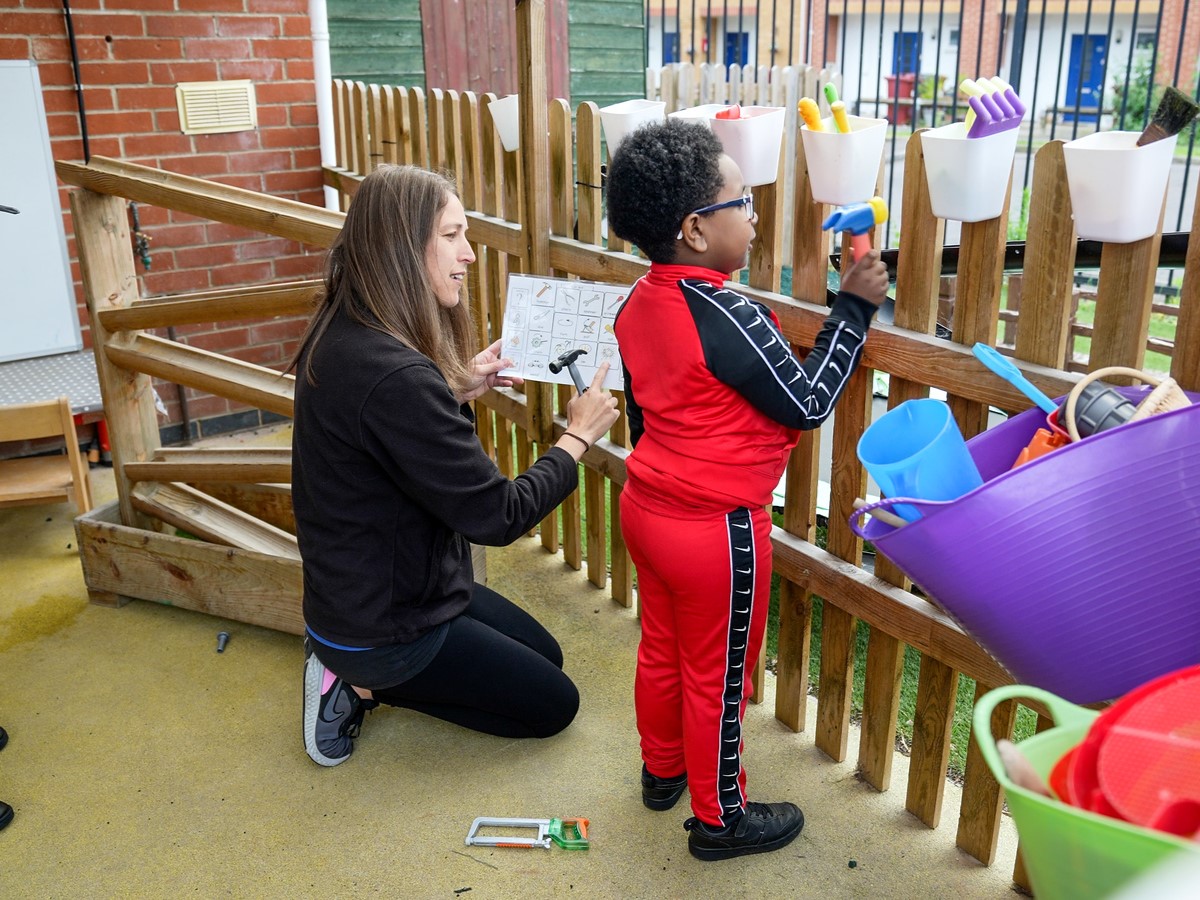
    • Visuals (pictures) – visuals help to reinforce what is being said and help children to fully understand what is being asked of them. This can include the use of photos, PECS, Makaton symbols, Widgets, drawings. They are especially useful to show the routine for the day on a visual timetable, at times of transitions to help children move from one activity to another, and when asking children to make a choice between one activity/resource and another.
    • Objects of reference – These are objects that have particular meanings assigned to them that we use if the child is not yet ready to use pictures. They aid understanding of verbal instructions by giving children a very visual clue about what is going to happen next. For example, giving a child a nappy to show them they are going to have a nappy change.
    • Now and Next/First and Then: A board with the words ‘Now’ or ‘First’ on the left-hand side and ‘Next’ or ‘Then’ on the right-hand side, with a space underneath to add a symbol or photograph.  We use these to help a child to transition from one activity to another, to break down a sequence during an activity, or to show what activities are going to be done during a one-to-one focused learning time. 
    • Communication Boards: These are laminated pieces of paper which can be specific to a certain activity (e.g painting) or time of day (e.g snack time) or can be more generalised to reflect resources available in the playroom or garden. On the boards are symbols of common words (e.g I, want), nouns, verbs and adjectives which enable the user to point at the symbol to show what they want to communicate. 
    • Songs/stories – we offer shared singing and story times every day to encourage listening skills and group participation. We use rhymes and stories which include repetition and rhyming words, and support these with the use of props and signs to make them as visual and fun as possible.
    • Attention Autism/Bucket – an intervention approach developed by Gina Davies to support speech and language development for Autistic children. We carry out ‘bucket’ sessions for those children who are ready to access and try to build attention and early communication skills through fun and engaging activities using the 4 stages of the Attention Autism program. 
    • Intensive Interaction – by taking the child’s lead and engaging in their interests we are able to work on the interaction skills of children who are at the early levels of development. It helps children to learn the benefits of eye contact, facial expressions, body language, and turn taking opportunities, and builds their confidence at being around others.
    • Line of vision – we always get down to the child’s eye level when communicating with them to make sure they can see our mouths moving and the eye contact we are giving them. Using their name to gain their attention and being close to them reinforces that we are talking to them.
    • Allow time – when communicating we ensure we give them time to process and respond. They may not respond with speech but could give eye contact, pass a visual, or reach out to show that they are listening. Giving children time to respond before speaking and signing again shows that we respect their views and want to engage in a back-and-forth conversation. 
    • Sensory input – we think about the environment and ways in which we could improve it to reduce noise or distractions. This includes minimising wall displays and resources in the playrooms, adding soft furnishing to reduce noise, and ensuring there are quiet areas to go to when needed. 
    • Timers – These are used to give warnings as to how long is left of an activity before a transition takes place. We use sand timers and other visual countdowns, alongside using our visual timetable and the use of speech and signs. This gives the children a clear understanding that a transition is about to happen and helps to reduce frustrations. 
    • Consistency – we ensure that every day we offer the same forms of communication in as many situations as possible to build on their understanding and give them the tools they need to become confident communicators themselves. 

    By using all these strategies, we hope to improve the speech and language skills of the children we support, as well as give guidance to parents and families about how to support their children at home. We continually build on our knowledge through training and shared learning opportunities, as well as learning from the children and families themselves as every child is unique. We hope to improve the speech and language skills of those with SEND to give them the best possible start which will then be extended and built on as they move on to school and beyond.  

    Visit Speech and Language UK

    Abi Preston-Rees – Lead Trainer, Dingley’s Promise

  • Early Education and Childcare Coalition Pulse Check

    Early Education and Childcare Coalition Pulse Check

    Dingley’s Promise are proud to be part of the Early Education and Childcare Coalition. The recent EECC Pulse Check reflected that 68% of all voters think the next government should prioritise early education and childcare as much as primary school, with the same number saying more funding for early years would benefit the country in the long-term. We are committed to raising the voices of children, families, early years settings and local authorities to ensure that early years education is given greater priority by all decision makers and that children with SEND are given every chance possible of fulfilling their potential.


    • 68% of all voters think the next government should prioritise early education and childcare as much as primary school
    • The same number says more funding for early years would benefit the country in the long-term, while 44% think funding early education and childcare now would actually save the country money in the long run
    • 81% of parents of children under five are concerned about the availability of places in England
    • 80% of all voters think every child should be able to access a place in early education and childcare no matter where they live in the country


    Read the full pulse check findings here.