Category: DP Training

  • Creating an environment to nurture belonging

    Creating an environment to nurture belonging

    Establishing an environment in which children feel welcomed, safe and like they belong is vital to creating provision which meets the needs of the many not just the few. We know that many strategies and adjustments we make for children with Special Educational Needs and Disabilities (SEND) can support all children and can enhance the learning of those with and without emerging or identified needs. Therefore, creating inclusive provision in the early years is key to providing opportunities for learning and development for all children.

    Why it matters

    For all children the environment they learn and grow in can shape their sense of belonging and their aspirations for the future. It’s not just about physical space—it’s about the attitudes, ethos, and values that surround them. When educators and peers embrace inclusion, it sends a powerful message: every child is valued, accepted, and celebrated for who they are.

    Supporting inclusion while meeting a child’s needs has a profound impact on their mental health and wellbeing. It shifts the focus from trying to help the child to fit the environment and instead adapting the environment to meet the child’s needs. This mindset opens up possibilities, helping children feel seen and supported rather than isolated or misunderstood.

    A whole setting approach

    Developing your inclusive provision is most impactful when the whole setting is working toward the same goal. Having the same expectations, attitudes and practice of inclusion will ensure that it becomes embedded every day in the setting. Ensuring all team understand the expectations for the environment and curriculum when in comes to inclusion will support you in working towards the same goals.

    1. Inclusive Ethos and Leadership
    • Leaders champion inclusion as a core value.
    • Inclusion is embedded in the setting’s vision, policies, and daily routines.
    • Staff are empowered to reflect on and improve inclusive practices.


    1. Staff Training and Development
    • Regular CPD on inclusive pedagogy, SEND, cultural competence, and trauma-informed care.
    • Staff are confident in identifying and supporting diverse needs, working together to share knowledge, strategies and ideas.
    • Peer support and reflective practice are encouraged, this may be through informal discussions or one-to-one conversations.


    1. Environment and Resources
    • Spaces are physically accessible and sensory-friendly.
    • Resources reflect diverse cultures, languages, and abilities.
    • Quiet areas and flexible spaces support emotional regulation and different play styles.


    1. Curriculum and Pedagogy
    • The EYFS framework is used flexibly to meet individual needs.
    • Activities and experiences are adapted so that all children have the opportunity to participate and engage.
    • Stories, songs, and play materials represent a wide range of identities and experiences.


    1. Family and Community Engagement
    • Families are welcomed as partners in learning.
    • Communication is inclusive (e.g., translated materials, visual aids).
    • Community links enrich the setting and promote belonging.


    A Framework for Change

    Reflecting on our practice is essential as it enables us to grow, adapt and create more inclusive and responsive environments for the children within our care. It can help us to identify what works well in our settings and can enhance learning for all children. Vitally, it can also highlight how some assumptions, biases or routines may unintentionally exclude children. By uncovering these blind spots we can make adjustments and adaptions to remove these barriers and give every child equal access to learning in a way which is right for them.

    Reflecting on your setting may happen in many different ways, you may focus on one question at a time or utilise one-to-one discussions with your team members to gain insight from people across the different roles of your organisation. Creating truly inclusive provision won’t happen overnight, or through asking one golden question of yourself or your team, but by regularly asking the right questions, you can keep inclusion at the forefront of everybody’s minds and make conscious choices to improve your practice.

    Asking one reflective question a day can be a powerful way of developing your knowledge and practice as an educator.

    *What challenging behaviour did I face today? How did my response support the child? Could I have responded differently?

    *How did I meet a child’s emotional and developmental needs today? How could I have approached it differently to achieve better outcomes

    *Was my language inclusive and affirming? What alternative language could I have used?

    These reflections allow us to notice patterns, behaviours and subtle cues that we may have missed in the moment.

    Consider your actions and those of the team around you and establish what you wish to reinforce or change about your practice tomorrow and in the days ahead.

    Using a framework of reflective questions regularly, will support you in developing a consistent whole setting approach to inclusion. Focusing you to cover all areas of inclusion and enabling all team members to understand where you are on your reflective journey to inclusion.

    Dingley’s Promise have developed a reflection framework to support whole setting inclusion, ensuring continual and honest reflection and adaptation towards inclusion and keeping inclusive practice, ethos and values at the heart of practice.

    The framework is designed to highlight key questions to support the embedding strong inclusive practice across your provision, including through your leadership, environments, educators and transition processes. Visit www.dingley.org.uk/reflectiveframework  to access our reflective framework and other Dingley’s Promise resources.

    Meggie Fisher, Head of Quality for Dingley’s Promise


  • Speech and Language Challenges at a Record High

    Speech and Language Challenges at a Record High

    New figures released from Speech and Language UK show that at least 1.9 million primary and secondary aged children are now estimated to be behind with talking and understanding words. This equates to 20% of all pupils throughout the UK – 1 in 5 school aged children – the highest number ever recorded. 

     YouGov, an Internet-based market research and data analytics firm, commissioned a survey and found that: 

    • 80% of teachers surveyed think children in their classroom are behind with their talking and/or understanding of words. 
    • 73% of teachers surveyed think that children’s speech and language is not prioritised by the Government. 
    • 53% of teachers surveyed don’t believe they have sufficient training to support pupils’ speech and language in the classroom. 

    To drastically improve the lives of 1.9 million children, Speech and Language UK is urging Government and school leaders to take a number of actions to improve these figures. They have put together a strategy with 5 aims which they hope to achieve over the next 5 years.   

    Speech and Language development is a big part of the work we do at Dingley’s Promise. The majority of children who access our services are at the beginning of their communication journey and have been recognised as being behind with the vital skills needed to communicate their wants and needs. Aim 1 of the Speech and Language UK strategy is toMake speech and language central to more schools’ and nurseries’ everyday practice across the UK’. They want to do this by investing in more training for school and nursery staff to ensure that they use positive speech and language practices every day. This is vital for the future improved development of children’s communication and at Dingley’s Promise we already have several speech and language strategies in place to support children with special educational needs and disabilities and their families. 

    We believe that communication is a key element in all learning. It improves self-confidence and wellbeing, helps build positive relationships, increases ability to learn, and ultimately leads to a better future. Not all children with SEND will learn to speak, but it is important to give them a voice and allow them to communicate in a way that is suitable for their age and stage of development. A Total Communication Environment will help to do this and requires everyone to work together to ensure that as many forms of communication as possible are consistently used, rather than relying purely on words and hearing. 

    Here are some of the key strategies that we use at Dingley’s Promise to create a Total Communication Environment: 

    • Reduced language – when giving instructions we keep language simple and to the point. Children will often only remember the last piece of the information, so it is important to break down the sentence and make it appropriate for the child’s current level of understanding. 
    • Signing (Makaton) – we use signs and gestures alongside speech to make what we are communicating more visual. Signing is used even if none of the current children rely on this to communicate as modelling signs consistently encourages children to use them too and often signs are learnt quicker than speech in children who are struggling to talk. 
    • Visuals (pictures) – visuals help to reinforce what is being said and help children to fully understand what is being asked of them. This can include the use of photos, PECS, Makaton symbols, Widgets, drawings. They are especially useful to show the routine for the day on a visual timetable, at times of transitions to help children move from one activity to another, and when asking children to make a choice between one activity/resource and another.
    • Objects of reference – These are objects that have particular meanings assigned to them that we use if the child is not yet ready to use pictures. They aid understanding of verbal instructions by giving children a very visual clue about what is going to happen next. For example, giving a child a nappy to show them they are going to have a nappy change.
    • Now and Next/First and Then: A board with the words ‘Now’ or ‘First’ on the left-hand side and ‘Next’ or ‘Then’ on the right-hand side, with a space underneath to add a symbol or photograph.  We use these to help a child to transition from one activity to another, to break down a sequence during an activity, or to show what activities are going to be done during a one-to-one focused learning time. 
    • Communication Boards: These are laminated pieces of paper which can be specific to a certain activity (e.g painting) or time of day (e.g snack time) or can be more generalised to reflect resources available in the playroom or garden. On the boards are symbols of common words (e.g I, want), nouns, verbs and adjectives which enable the user to point at the symbol to show what they want to communicate. 
    • Songs/stories – we offer shared singing and story times every day to encourage listening skills and group participation. We use rhymes and stories which include repetition and rhyming words, and support these with the use of props and signs to make them as visual and fun as possible.
    • Attention Autism/Bucket – an intervention approach developed by Gina Davies to support speech and language development for Autistic children. We carry out ‘bucket’ sessions for those children who are ready to access and try to build attention and early communication skills through fun and engaging activities using the 4 stages of the Attention Autism program. 
    • Intensive Interaction – by taking the child’s lead and engaging in their interests we are able to work on the interaction skills of children who are at the early levels of development. It helps children to learn the benefits of eye contact, facial expressions, body language, and turn taking opportunities, and builds their confidence at being around others.
    • Line of vision – we always get down to the child’s eye level when communicating with them to make sure they can see our mouths moving and the eye contact we are giving them. Using their name to gain their attention and being close to them reinforces that we are talking to them.
    • Allow time – when communicating we ensure we give them time to process and respond. They may not respond with speech but could give eye contact, pass a visual, or reach out to show that they are listening. Giving children time to respond before speaking and signing again shows that we respect their views and want to engage in a back-and-forth conversation. 
    • Sensory input – we think about the environment and ways in which we could improve it to reduce noise or distractions. This includes minimising wall displays and resources in the playrooms, adding soft furnishing to reduce noise, and ensuring there are quiet areas to go to when needed. 
    • Timers – These are used to give warnings as to how long is left of an activity before a transition takes place. We use sand timers and other visual countdowns, alongside using our visual timetable and the use of speech and signs. This gives the children a clear understanding that a transition is about to happen and helps to reduce frustrations. 
    • Consistency – we ensure that every day we offer the same forms of communication in as many situations as possible to build on their understanding and give them the tools they need to become confident communicators themselves. 

    By using all these strategies, we hope to improve the speech and language skills of the children we support, as well as give guidance to parents and families about how to support their children at home. We continually build on our knowledge through training and shared learning opportunities, as well as learning from the children and families themselves as every child is unique. We hope to improve the speech and language skills of those with SEND to give them the best possible start which will then be extended and built on as they move on to school and beyond.  

    Visit Speech and Language UK

    Abi Preston-Rees – Lead Trainer, Dingley’s Promise

  • Outdoor Learning in the Early Years

    Outdoor Learning in the Early Years

    Outdoor learning is an integral part of what we do in the early years as it can offer so many experiences and learning opportunities for our children. We know that for some children the opportunities they have to spend time in the outdoors is limited, and through our knowledge of each individual child we can offer a range of experiences that add to and enhance their cultural capital as they learn and grow with us.

    Being outdoors supports children’s learning holistically. What better way to discover rain than to feel it on your skin, to jump up and down in the puddles, to listen to the splashing and the pitta patter of the raindrops; can you catch the raindrops in a bucket, can you use the water to make marks on paper, can you talk about what you are seeing, hearing and experiencing? All of these outdoor experiences don’t require more than a bucket, paintbrush and appropriate clothing! With the further input of child centred and open-ended resources the opportunities for children in the outdoor environment can be extended even further. When considering the organisation of your outdoor space, reflect on the areas of learning and look at how they will interlink as children begin to deeply engage with what is provided for them.

    By introducing a few planks, tyres and safely stackable crates you can create the opportunity for children to explore their physical development but also other areas of learning in the Early Years Foundation Stage; they may learn to work together to create a pirate ship and go on an adventure, they might build an obstacle course and explore their balance and ability to climb, they could be problem solving working out how many of each resource they need to achieve their goal. Practitioners may have great intentions when they set up an experience for children however something can be anything a child wants it to be and we must be confident to follow children’s interests and let them take the lead in their learning. That stick they find on the floor can be a broom, a steering wheel, it could be Stick Man and he is looking for his next adventure and those leaves can be the path he follows! These two examples demonstrate that simple resources or simply the outdoors itself can provide unlimited opportunities for children to follow their imagination, engage and develop a variety of skills. It is not that we need to spend lots of money on wonderful outdoor specific resources in order to meet the intention of your learning, it is about how we can adapt what we have. There are items all around your settings that can be transferred outside to create an incredible and stimulating learning experience that will have an entirely different impact than they would have done in the indoor environment. Our outdoors does not need to be a replication of our indoors, in fact it should be an extension, a place to consider how we can safely push the boundaries of our children’s learning. 

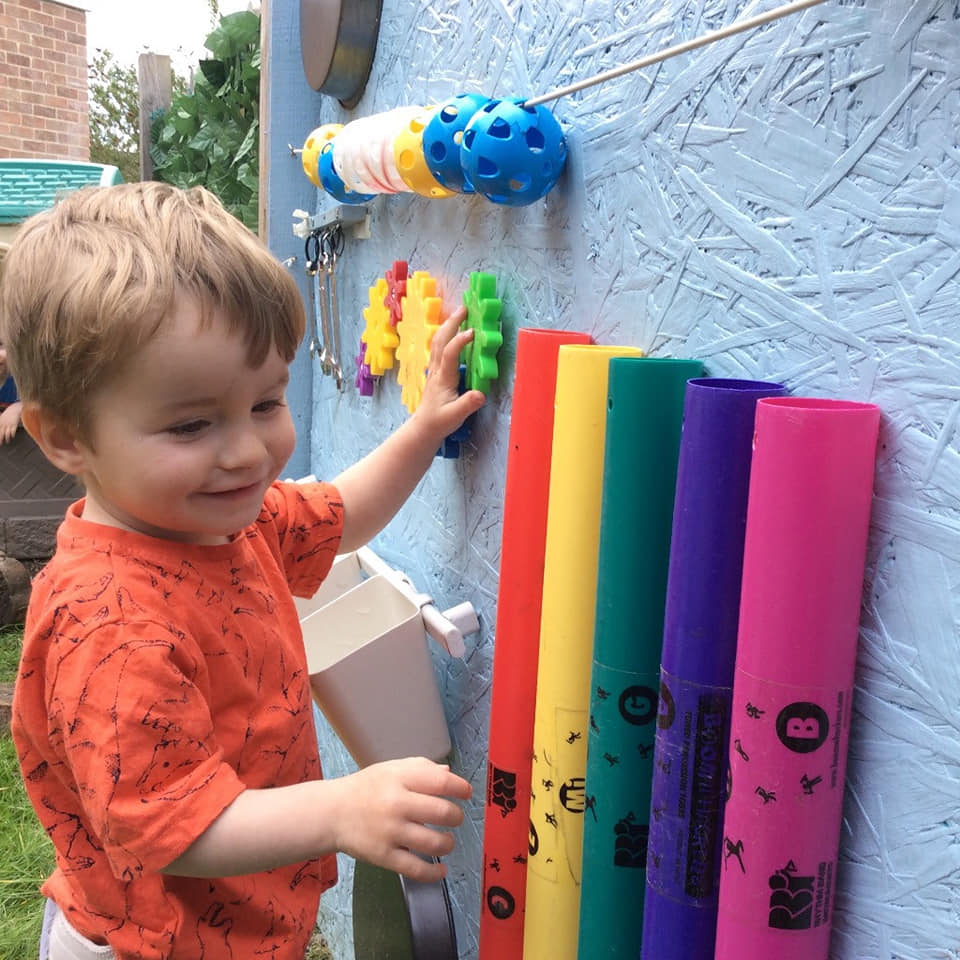
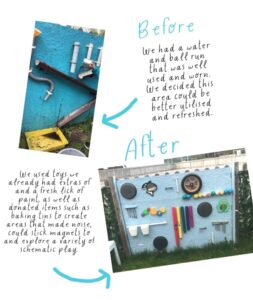
    Research demonstrates that different sounds, sights, textures, smells support children with special educational needs to regulate themselves whilst simultaneously promoting brain development and enhancing social skills. Some settings report that their outdoor spaces are missing this sensory stimulation that would largely benefit children. Again, this does not need to be costly process to ensure that we are able to offer sensory play within our outdoor environments. A few potted plants around the garden which include plants such as lavender or parsley will provide children with things to smell, touch and even safely taste. Some sticks, old pots and pans or a windchime will add to the sounds that can be heard and created, but you can also encourage children to listen out for the birds, insects, and vehicles in the area. Having a range of these objects around your outdoor area will encourage children to explore at their own pace and to embrace the natural world around them leading to a greater understanding of the community in which they live.

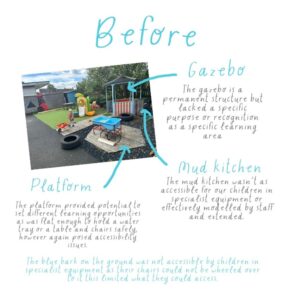
    As a group of settings, we have reflected on the outdoor environment and how they support children’s learning and development. Through these conversations with practitioners, they have been able to consider what works well for their children and what they could change or add to ensure we are offering the best opportunities for each child. These collective conversations were a useful starting point to ensure the team thought holistically about the environment and individual children and were able to create a plan tailored to children’s needs and interests.

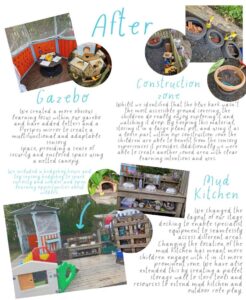
    They created an action plan which highlighted the need to include more ‘natural’ greenery in some of the gardens to break up the views of hard concrete and man-made materials and structures in the immediate surrounding area. Another area of development they had considered was how they could make all learning opportunities more accessible to all children especially as they enter the more challenging weather conditions.

    Together, they worked as a team to plan and implement the changes they agreed and adapted their outdoor environments to reflect the learning needs, styles and interest of the children who access their environment daily.

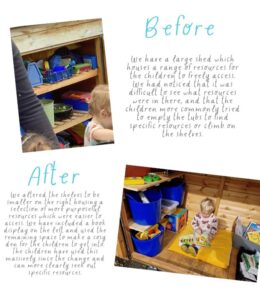
    As you can see, they have focused on enhancing a mixture of the resources and zones available within the garden, and how these could be effectively stored and rotated. Their planning and delivery of outdoor learning opportunities now more effectively reflects the indoor environment, in that they are both set up purposefully and with the learning intentions for children in mind ensuring there’s targeted resources and learning opportunities for each area of the Early Years Foundation Stage.

    The ability to reflect on the strengths and areas for development in all our practice is a great way of continuously monitoring the experiences children receive when they are with us and will enhance the skills of all early years practitioners as they will understand why a space is used the way it is or why a child needs resources made available in a particular way because they have taken the time to recognise and understand the unique learning of the individual child.

  • Dingley’s Promise receives funding from Comic Relief’s Change Makers

    Dingley’s Promise receives funding from Comic Relief’s Change Makers

    Dingley’s Promise receives funding from Comic Relief’s Change Makers initiative to tackle lack of early years spaces for children with SEND

    Comic Relief has today announced a brand-new £9.1 million programme to support new initiatives that will deliver vital long-term support to thousands of vulnerable people across the UK during the Covid-19 recovery.


    One of the successful recipients is Dingley’s Promise in Berkshire. The charity will use an investment of  £545,789 to design and deliver ten training courses to help early years practitioners be more inclusive of children with Special Educational Needs and Disabilities (SEND) and to facilitate the development of early years inclusion strategies in thirty local authorities. All of this will take place with a focus on parental input, on building the voice of the child, and on wider influencing of sector leaders and government. Children with SEND and children in the early years are among the most affected by the pandemic, and so this project will directly contribute to opening more spaces for them in the early years at a time that they have never needed early intervention more.


    Catherine McLeod MBE, Chief Executive of Dingley’s Promise, said; ‘We are over the moon about being able to deliver this project. We are committed to transforming the early years for children with SEND, and want to change the fact that currently only 19% of local authorities have enough spaces for children with SEND in the early years. This project will build a movement for greater inclusion, and will open up spaces to allow more children than ever before to thrive in the early years.’


    The Change Makers programme is launching twenty new initiatives involving 45 organisations, spanning all four nations of the UK, over the next five years. They will tackle serious issues that have seen increased demand for help throughout the pandemic including homelessness, domestic abuse and mental health. The programme aims to find innovative solutions to problems affecting vulnerable people that have been overlooked or under-resourced at a local, regional and national level.


    Samir Patel, CEO of Comic Relief, said: “It’s fantastic that through our new Change Makers programme we are able to support 20 ‘game changing’ projects that are working with thousands of vulnerable people and families throughout the UK. Each project aims to provide vital long-term support and make a real positive impact on communities hardest hit by the pandemic.”


    For more information visit www.comicrelief.com/funding

  • Dingley’s Promise launches FREE Transition Training Course

    Dingley’s Promise collaborates with the Early Years SEND Partnership to launch FREE Transition Training Course

    Following the success of the charity’s Inclusion Training Offer, launched during the Covid-19 lockdown, Dingley’s Promise has become the newest member of the Early Years SEND Partnership and will offer a new course that centres around transitions in the Early Years.


    The course, titled Early Years SEND Transition Training, is aimed at professionals working with children in the EYFS, Special Educational Needs Coordinators (SENCOs) in receiving primary schools, and relevant Local Authority staff. It focuses on how to best support children with special needs and disabilities (SEND) to have the best transitions from Early Years settings to school. 


    The training takes place online via workbooks, recorded seminars and live group webinars led by trainers. The course is divided into three units which delve into the transition process from the point of view of the child, the family, and the settings. It will consider why children with SEND (and their families) are likely to find transition more challenging, and look at what strategies can be used to benefit everyone involved in the process. The course will also highlight how to support well being and the impact of Covid-19. 


    180 free spaces are on offer to local authorities across England, with a maximum of three people from each area. Those three spaces will first be offered to an Early Years Practitioner, a school SENCO, and a local authority employee, but the most important thing is that participants are actively committed to working in their local area to improve transitions for children with SEND. 


    Dingley’s Promise is also facilitating transition planning processes in four local authority areas in the south as part of the same project, and in those areas there will be local ‘Action Learning Sets’ and an additional three places on the training to give them the most information and expertise possible during the process.


    Sign ups for the training are open and will close on the 20th of August. 


    Sign up here


    Dingley’s Promise looks forward to working with the first cohort of trainees in September and is proud to be spearheading a movement to improve transitions for children with SEND nationwide.


    Transition Training N flyer Transition Training S Flyer

  • Dingley’s Promise launches FREE training offer in Inclusive Practice


    Across the country, we are all contributing to the safety of others by self distancing and working from home. At this time, Early Years Practitioners may be looking for ways to keep busy and develop their skills while they are at home.

    In line with their commitment to improving Early Years provision for children with special educational needs and disabilities (SEND), children’s charity Dingley’s Promise has developed and launched a new training module in Inclusive Practice, which is being offered free of charge to anyone it would benefit.

    The new course, titled an ‘Introduction to Early Years Inclusive Practice’, forms part of the charity’s response to the Covid-19 pandemic and focuses on ensuring children with SEND are included in the mainstream wherever possible. With the charity’s centres being closed, Dingley’s Promise has adapted to supporting children and families remotely, and remains dedicated to providing every child with the best start in life, especially in these challenging times.

    Chief Executive of Dingley’s Promise Catherine McLeod MBE said ‘we are so happy to be able to offer this module for free across the UK as we believe that it will help to spread inclusive practices in the early years. When we all return from this crisis we could be returning to more opportunities for children with SEND in the early years than ever before.’

    Dingley’s Promise is a leading voice in the Early Years field and advocates for wider inclusion nationally, through relationships with organisations such as the Disabled Children’s Partnership. The charity also already runs a Level 3 qualification ‘Certificate in Early Years Inclusive Practice’, accredited by NCFE and supported by nasen (National Association for Special Educational Needs), making them well placed to launch this new training initiative.

    The charity pledges that the free training offer will be accessible to all for as long as the lockdown continues.

    For anyone who is interested in the course, a simple online form (https://www.dingley.org.uk/covid-19-response/#training) can be filled in and once an applicant is accepted, the training manual will be sent via email.


    Free training flyer April 2020

  • Dingley’s Promise Early Years Inclusion Training goes national

    Leading children’s disability charity, Dingley’s Promise has partnered with Action for Children, to spread their expertise and build more inclusion across the country. The two organisations have entered a partnership around the ‘Certificate in Early Years Inclusive Practice’ developed by Dingley’s Promise and accredited by NCFE. The first stage of this partnership will be a pilot of delivering the training to Action for Children nurseries in the Northeast of England. Funded by Sylvia Adams Charitable Trust, the pilot will track the impact of the training on early year’s practitioners, and on the children with special educational needs and disabilities that they work with.

    Dingley’s Promise launched this unique training programme in January 2018, and had over 50 trainees sign up in the first year. Through their own evaluations of the training, they have found that 100% of trainees felt the course had benefited their own practice, and 100% felt it had benefited their organisation. Early figures suggest that the training results in a doubling of the capacity practitioners feel they have to support children with SEND.

    In the UK currently, only 22% of local authorities reported having sufficient places for children with SEND in the early years, and only around 25% of children with SEND are taking up their 30 hour early year’s entitlement. The gap between children with SEND and other children continues to grow across the country, and this lack of access in the early years can only contribute to making this gap even wider.

    Chief Executive of Dingley’s Promise Catherine McLeod MBE said: ‘The inclusion training is an important part of ensuring that children with SEND have equal access to early year’s education, and it is our hope that in the future every mainstream setting in the country will have the opportunity to take the training.’

    Head of Early Years at Action for Children Sarah Read said: ‘We want to ensure inclusivity is at the centre of our early years services at Action for Children and we’re really pleased to be working with Dingley’s Promise on this exciting project, which really puts children at the heart of the training for our front-line staff. It’s vital that people working with children in their early years sector are equipped with the practical skills and knowledge to help them effectively support children with SEND.’

    Certainly this partnership of small regional charity with large national charity will ensure that there is an independent evaluation of the impact of the training, and more people than ever before will hear about the benefits of ensuring early year’s practitioners are knowledgeable and confident in working inclusively with children with SEND.

    group pic