Category: Early Years SEND

  • CEO Catherine McLeod’s response to the government’s early years funding consultation update

    CEO Catherine McLeod’s response to the government’s early years funding consultation update

    Dingley’s Promise calls for better access to early years SEND funding

    Yesterday’s release of the government’s response to the early years funding consultation was an opportunity for necessary and immediate action to be taken to improve access to early years entitlements for children with Special Educational Needs and Disabilities. Recent research carried out by Dingley’s Promise regarding the introduction of under 2’s funding entitlements confirmed that 57% of settings believe they will not be able to take any more children with SEND when these changes come into force. This is at a time when one in five parents of children with SEND are already reporting they have been turned away from an early years setting.

    Whilst we recognise the important move to increase the eligibility to access SEN Inclusion Funding (SENIF) and Disability Access Funding (DAF) to more age groups, there are ongoing concerns around the challenges of accessing this funding. Access to DAF funding is dependent on the family having successfully applied for Disability Living Allowance (DLA); something that many families in the early years are not ready or equipped to do. With 48% of local authorities saying they are underspent on their DAF budgets, Dingley’s Promise believes that the link with DLA is having a negative effect on take up, something which must be addressed to make the funding process more accessible.

    Catherine McLeod MBE, Chief Executive of Dingley’s Promise reflects on the barriers:

    “Currently, when settings cannot quickly access funding to support children with SEND it becomes a barrier to inclusion. We must remove all barriers to accessing the funding needed, to enable settings to be more sufficient and confident of supporting children with SEND effectively, and to reduce the numbers of children being turned away”

    The Government’s response to the consultation acknowledges the current issues, stating: ‘As qualifying for DLA is contingent on a SEND diagnosis, there is a fear that many children will miss out due to the process involved in a child receiving a SEND diagnosis’. Yet despite this, the decision to proceed with the proposal to use DLA as the proxy for allocating DAF was maintained. Dingley’s Promise has raised this issue with the Department for Education, both as part of the consultation and on release of their response. We sincerely hope they will consider changing the current process to remove the barriers which prevent settings from effectively supporting our most vulnerable children in the early years.

    Response to funding consultation: https://assets.publishing.service.gov.uk/media/65670dd9312f40000de5d56c/Early_years_funding_-_Extension_of_the_Entitlements_Consultation_Response.pdf

    Dingley’s Promise Manifesto for Early Years Inclusion: https://dingley.org.uk/manifesto/

  • Dingley’s Promise joins the Early Education and Childcare Coalition

    Dingley’s Promise joins the Early Education and Childcare Coalition

    Working together for an early education and childcare sector that delivers for our children, for parents, and for the economy.

    Dingley’s Promise is part of a new early years-focused coalition that has been formed with the goal of challenging all political parties to be more ambitious on early education and childcare reform in England. We’re extremely excited to be a part of a group of over 30 organisations helping to improve the long-term outcomes for children with SEND in the Early Years and ensuring the development of an early education and childcare system that works for all; with fair pay, conditions, and adequate funding.

    The Early Education and Childcare Coalition (EECC) has been developed by gender equality thinktank the Women’s Budget Group, and funded by the Kiawah Trust, a charitable foundation that supports initiatives to tackle educational and gender inequality. It aims to shape future policy for the sector with the benefit of insight and expertise from leading early years voices. Working with all political parties to encourage real focus on the early years sector at the next general election.

    The EECC consists of 30 leading organisations and charities including the Early Years Alliance, as well as Save the Children, the National Children’s Bureau, UNICEF, and other leading voices in the sector.

    Dingley’s Promise is excited to be a part of this vital coalition at a critical time for the early years sector. Families, settings and government want children with Special Educational Needs and Disabilities (SEND) to get the best start, and to be able to experience inclusion wherever possible, and it is essential that this happens in the earliest years when children have the best chance to play and learn alongside their peers. With the latest research showing that only 18% of local authorities believe they have enough provision for children with SEND, and families increasingly reporting being turned away from settings, there has never been a more important time than now to join together to build a more equitable and inclusive early education system.

    Neil Leitch, CEO of the Early Years Alliance and supporter of Dingley’s Promise said: “The formation of this coalition could not come at a more pivotal moment for the early years. There is no doubt that having so many voices from across the education, children’s, parenting, and business sectors come together in this way sends a hugely powerful message to the government about the vital importance of early education and care.

    Find out more about the coalition here Early Education and Childcare Coalition (earlyeducationchildcare.org)

  • Statement on Government’s SEND and alternative provision improvement plan

    Statement on Government’s SEND and alternative provision improvement plan


    2nd March 2023

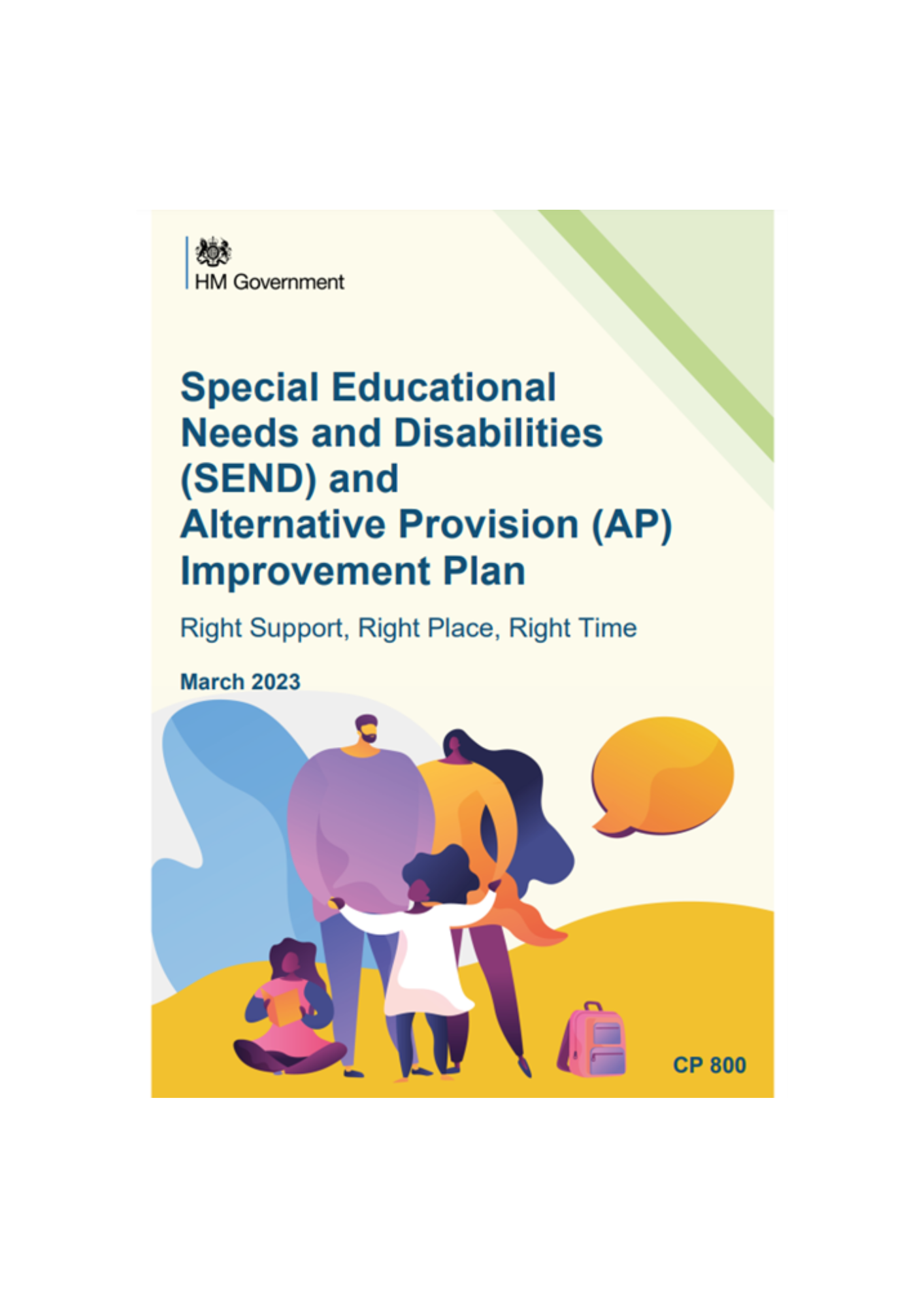
    We welcome the release of the Government’s SEND and AP Plan, and are particularly happy that within this plan, early education is repeatedly acknowledged to be a key stage in the wider educational journey of every child.

    The Plan recognises ‘the important role of the early years sector in the early identification of needs and in building up effective working relationships with parents about their child’s needs’. Reflecting on the consultation process, the Government notes that ‘respondents highlighted the crucial role of high-quality early years support in preventing unnecessary escalation of need and providing children with a strong foundation for their future educational journey.’

    For the early years sector, this formal recognition of the vital role we play in providing the best start for children with SEND is crucial and we appreciate the actions taken by the government in response to requests for more details on the early years in the plan. We also welcome the news that the review of the Level 3 early years educator qualification is likely to see the addition of a section on SEND  which will  increase knowledge, understanding and confidence of all newly qualified early years practitioners to work inclusively.

    The key action linked to the early years is the commitment to provide more Level 3 Early Years SENCO training. While this is important, we agree with the view also expressed in the plan that ‘a whole-setting inclusive ethos improves the sense of belonging for those with SEND’. We would therefore encourage development of the  plan to incorporate inclusion training for ALL early years practitioners rather than focusing only on the SENCO.

    We welcome the inclusion of early years in other areas of the plan including; the focus on high quality early intervention, the creation of practice guidance, national standards, early years sufficiency data, transitions to school, Ofsted area inspections and funding.

    As a charity running early years specialist Centres across the country and delivering a vital service, we are concerned that early years is not mentioned in conjunction with strengthening AP provision. We would encourage the analysis of the use of independent specialist AP in the early years to understand whether this has similar benefits for children and families as it does later in the education system. If similar benefits are found, then there should also be a focus on supporting the development of more of this kind of provision in the early years.

    We are committed to supporting the development of the SEND and AP system as described in the plan, with a focus on ensuring that where the plan makes clear recommendations in relation to early years, these result in clear actions.

    This is an encouraging starting point for an improved SEND system that acknowledges the early years as a vital stage in all children’s development and recognises that early intervention is critical both for both children and families.

    Catherine McLeod – CEO Dingley’s Promise

    Read the Government plan in full here https://www.gov.uk/government/publications/send-and-alternative-provision-improvement-plan

  • EDI – The journey that never ends

    EDI – The journey that never ends

    Catherine McLeod – Dingley’s Promise CEO


    This week, I have been reflecting on the Equity Diversity and Inclusion (EDI) journey of Dingley’s Promise over the past few years. We have recently opened a new Centre for the first time in over 20 years. During the set up of the new Centre, EDI was very much on my mind and on visiting the Centre before opening we reviewed the materials on display and found that they did not represent the diverse community of the area. This opened up a wider conversation about why it is important that children see themselves in the setting, and how we can work with every family so that they feel not just welcomed, but celebrated.

    In our Centres we firstly make sure that books, toys and other resources represent a wide range of backgrounds. This means not just books specifically about diversity, but story books featuring different kinds of children and families. Next, we consider the core experiences our children have, and think about how those might differ for them. This could be in relation to food, to nursery rhymes, to stories, to familiar smells, to games and many other areas. It is about not assuming that what is normal to the practitioners is normal to the child, and understanding what is familiar and comforting to them. During a training session with our EDI advisor Liz Pemberton, an activity used incense sticks to elicit responses from practitioners. In the group I was in, one person said they smelt awful and like really bad washing powder. For me, they smelt like peace and calm because I lived in Sri Lanka for years and it reminded me of prayer time. We talked about how smells that can feel alien to the practitioner, could be the most familiar and calming to our children and families. As practitioners we have to constantly challenge the centering of what we automatically feel is normal, and explore what normal might be for our children and their families.

    It’s not just about how our children and families feel though. Our staff team has become more diverse over the past few years – something that we have worked hard to achieve as part of our EDI Action Plan. A number of job applicants have commented on the diversity demonstrated on our website and in our documents, and said that was a key reason why they applied to work for us. In one of our Centres, a new volunteer was advised to consider us by the Imam at her mosque – something that became possible because we had actively approached local faith leaders. We also recently reflected on the fact that we give an annual ‘Christmas Shopping Day’ to staff and have now changed this to a ‘Festive Shopping Day’ so that team members can take the day whenever they have their main annual festivities rather than assuming that would be Christmas. Like so many moments in our EDI journey, once we verbalised the issue it seemed so obvious and right that we had to change it – and also uncomfortable that we hadn’t realised it sooner.

    For us, EDI is a constant in our planning and development, and we expect to continue to do this work for as long as we are here. Although we have always thought of inclusion as something in our DNA because of the work we do to ensure children with SEND are included wherever possible, what we have realised is that we want to work strongly towards all kinds of inclusion – not just that related to disability. For that reason, we have supported Reading Pride, spoken on BBC radio with Drag Queen Story Hour, and ensured that we have books and materials representing all kinds of family structures. For that reason, we have not only taken our own journey related to race and ethnicity, but this year we will launch a short training course for early years practitioners to ensure that they have the knowledge and confidence to work inclusively with children and families from a range of diverse ethnic backgrounds. For that reason, we strive to attract men to work in our Centres so that our children can experience positive male role models in their earliest years alongside the strong women who already work for us.

    EDI work is constant – it will never be ‘done’. Where we are now is not a triumph – it is a work in progress as we try to be the best place for our children, families and teams to thrive and feel celebrated. For this reason, we will continue to reflect and learn. We will make mistakes and will sometimes overlook important issues, and it is up to us to listen, reflect and learn. Only when we are comfortable that we don’t have it all sorted out, and are ready to take criticism and learn from it, are we able to build meaningful equity, diversity and inclusion.


  • CEO Catherine McLeod on Recruitment in the Early Years

    CEO Catherine McLeod on Recruitment in the Early Years

    Last night our CEO Catherine McLeod spoke to BBC News on behalf of Dingley’s Promise about staffing and recruitment in the early years. As a sector, recruitment and retainment is a huge issue, and the struggle to find and keep good staff is having a direct impact on children with special educational needs and disabilities (SEND). Families are being turned away from settings as they don’t have the staff to meet the child’s needs, contributing to the exclusion of children with disabilities and creating stress and anxiety for families with no support.


    “Early intervention is absolutely vital; the earlier we can understand their needs and how we can support them, the better life outcomes they will have”


    At Dingley’s Promise we recognise and appreciate the highly skilled nature of the early years workforce, however in the current climate there is a lack of funding for staff and the cost of early years settings across the country. The importance of early intervention needs to be recognised for the huge impact it can have for children with SEND; investment in the early years is life changing for children and their families. As part of the All Party Parliamentary Group, we are committed to speaking out on the challenges faced by children with special educational needs and disabilities, and will continue to push for positive change in the early years.

  • Dingley’s Promise SEND Review Response

    Dingley’s Promise SEND Review Response

    Dingley’s Promise Response to the SEND Review –  

    Government consultation on the SEND and alternative provision system in England, March 2022

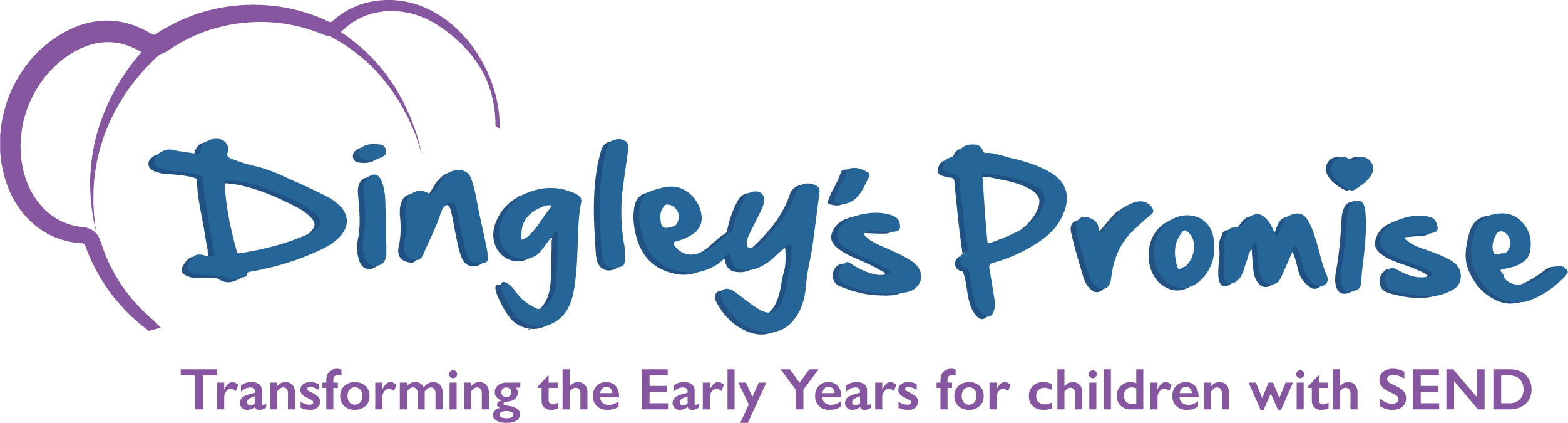
    Dingley’s Promise welcomes the much-anticipated SEND (Special Educational Needs and Disabilities) Review Green Paper and its commitment to bringing about major change in the current SEND system – a system that as the paper states, is currently failing to deliver improved outcomes for children and young people, is seeing the decline of both parental and provider confidence and is financially unsustainable.  

    Overall, there is an encouraging amount of focus on the early years, both in this paper and also in the Schools White Paper. Research from this paper shows that ‘high-quality early years provision for children significantly decreased the likelihood of a child being identified with SEN (Special Educational Needs) in later years.’ Stressing the important of early interventions to ensure the best long-term outcomes for children – and yet the early years remains hugely underfunded in comparison to the rest of the education system. MP Steve Brine called for early years professionals’ pay to match reception teachers’ pay in a recent debate in parliament. We would like to see more discussion around committing greater resources to the early years as much of the core investment described in the paper starts from the primary stage, with the exception of investment in training and CPD. 

    The paper recognises that the process is currently adversarial and parents fear being blamed for the needs their children have. Certainly, at Dingley’s Promise we have experienced parents being initially advised that they need parenting courses, rather than being listened to and trusted to know their children. This immediately tests the relationship between parents and professionals when they feel their voices are not being heard and their parenting skills are being challenged. The focus on the new plan on family hubs is therefore a positive one, which will hopefully establish a system of information and support around families. However, care must be taken to engage and really listen to family’s needs in this environment rather than purely imparting training. The commitment to having parents on local multi agency panels is welcomed, as in some areas this is still not commonplace, but to be effective this must include a diverse range of families and that their inputs being valued and acted upon.  

    The key area of concern remains around funding of the SEND system, new research released by the Early Years Alliance that showed 92% of early years settings have had to fund the cost of supporting children with SEND themselves – with 53% doing that on a regular basis. 28% of settings have declined a place for a child with SEND, and 14% expect the number of places for children with SEND to fall because they lack the funding to provide the right support. Dingley’s Promise have raised the issue of funding for early years send at the All Party Parliamentary Group for Childcare and Early Education, and we hope that the plans to simplify the SEND system and access to funding across the country will go some way to addressing this issue. The green paper states that there is recognition that early years’ settings are heavily impacted by local funding decisions, which they often feel they have minimal influence over.

    There will also be analysis of the use of inclusion funding in the early years addressing its ability to enable settings to provide the right support. The statistics above would certainly suggest that this in not working. Settings report specific difficulties where children are too young to access funding or are only able to access 15 hours of support when their entitlement is for 30 hours. If we do not resolve the funding issues for children with SEND in the early years, it will continue to drain the early years sector of funds at a time when it is already struggling. 

    We welcome the green paper’s plan for a simplified, standardised EHCP process that is digital and can travel across local authority boundaries. While only a small number of the total EHCPs in the country are in the early years, this will simplify the process for settings who often struggle with the administrative demands on this process. In turn, this will hopefully lead to more capacity in those settings to accept children with SEND who want to attend. It will also greatly help families who are either living on a border, or who need to move local authority area during the early years or at transition time. 

    The focus on increasing training in the early years for working effectively with children with SEND is much needed, but it should consider ensuring that every practitioner has an understanding of working inclusively with children with SEND, not purely focusing on a Level 3 qualified SENCO. Parents have expressed concerns about the impacts of only one person in a setting holding all the SEND expertise. For system-wide change, we recommend an approach that looks at raising the base knowledge levels of all practitioners around SEND, and ultimately this means that the standard Level 3 qualification should have a greater focus on this type of content. 

    Inclusion dashboards and local inclusion plans are in line with all the work we have done through the Early Years SEND Partnership, which suggests that to give children in the early years the best start and the best transitions to primary school, we must track key local data and really understand how inclusive we are. We look forward to sharing our learning on this through the consultation, and helping to shape what these dashboards look like, so that parents and professionals alike have a clear picture of what is working and what is not locally. We are committed to ensuring that every child who would benefit from accessing the mainstream in the early years has the opportunity to do so with the right support, however we must ensure that the mainstream is effectively trained, funded, and guided to support them effectively. Only once this investment is made will parents consider that mainstream education is a viable route for their child. 

    Taking into consideration the suggestions for changes to the current system, a few areas stand out across the age groups as needing more detail and consultation: 

    • Introduction of mandatory mediation. First impressions suggest this means an extra layer of bureaucracy for families rather than streamlining the current system. At worst, it could lead to exhausted parents being unable to go through another draining part of the process and not getting the right support for their children.
    • Lists of available schools tailored to parents. Rather than make the process simpler for families, this could mean that they have reduced choice and are discouraged from applying to settings not on the approved list. The reasons for adding settings to the approved list must also be very carefully assessed and completely transparent so that parents trust they are still going to get the best setting for their child. In addition, there needs to be careful planning on how to ensure decisions are not diagnosis-led but are tailored to each individual child and their specific needs and situation. The report states that there must be ‘flexibility’ in all of this, but careful planning and monitoring is needed to ensure clarity and accountability with this process, putting families at the heart of decision making.


    In conclusion, the Government green paper gives hope for real change to the current SEND system and reinforces the key role of the early years in achieving the best life outcomes for children with SEND.  

    For children with SEND in the early years to get the best experiences of early education and have the best chance of accessing the right provision, there must be significant improvements in resourcing and funding systems. Only with this level of investment will settings be able to offer the high-quality early intervention, support and transitions needed. We hope that this area is fully addressed over the coming months and years.  

    Standardised SEND systems have the potential to reduce issues across local authority borders and between various stages of the education system – issues that have especially affected the success of early years transitions to school, but these must be carefully developed, placing family’s needs at the centre of all planning. 

    Dingley’s Promise will strive to gather the views of families to feed into the consultation and ensure that the final document is fully reflective of needs and concerns on the ground. For any of this to make a real change, it is parents who must feel that it is transparent, and trust that the system is working in the best interests of their children. Without that trust, the fundamental issues the system is grappling with now cannot be resolved, and children and families will continue to have to endure exhausting processes to access their legal entitlements. 


    Read the full report here: https://assets.publishing.service.gov.uk/government/uploads/system/uploads/attachment_data/file/1063620/SEND_review_right_support_right_place_right_time_accessible.pdf  


  • CEO’s Blog: Learning from lockdown


    What can we learn from lockdown about how to best support children with SEND in the early years?


    Lockdown has been hard for everyone – but particularly for children with SEND and their families. Research from the Council for Disabled Children highlights how the early years sector is concerned about transitioning children back to settings, as well as transitioning them on to school in light of the long absence from settings. The research also raises concerns about the social and emotional impact of lockdown for children, and an increase in challenging behaviour as children struggle to cope with changes to routine and the loss of usual social interactions.


    As children started returning to our Centres in June, we were surprised to find that few of them had difficulty in returning and in a relatively short time they had all resettled well. Once settled, we focused on working with them and their families to understand what the impact of lockdown had been on them and their learning. What we found was that in general, the higher the needs of the child, the more they had fallen behind, which leaves us with concerns about those children who are still self-isolating with their families and are clinically vulnerable. For children with higher needs that experience a longer period of absence, the return to settings is likely to be more challenging.


    For those children, we have put in place a plan to focus on the therapy they have missed while in lockdown when they return in September. Our teams have identified activities and strategies for each child who had a Physiotherapy, Speech & Language, and Occupational Therapy Plan to ensure they can access as much professional therapy as possible. In addition, we have started planning activities for each of them that will complement that therapy whilst in the setting. We are also continuing to support children and families remotely through the summer holidays and are doing our best to ensure that they have a sense of belonging, structure and continuity in their lives.


    Specifically, the key learning areas that we discovered to have suffered the most during lockdown, among all of our children, are ‘health and self care’, and ‘listening and attention’. In order to help the whole cohort of children, we have planned a range of activities linked to these skills for all the children in our Centres in September so that we can contribute to recovering lost progress in these areas.


    Of course, all of this will be done very carefully so that children are not overwhelmed, and we are aware that it is unlikely children will fully catch up to where they would have been had lockdown not happened.


    More surprisingly though, we also found that some children had thrived during lockdown. The lack of pressure to conform to daily routine, the familiar surroundings and faces of home, and parents with much more time to support them, has meant that for some children lockdown has been a gift and they have developed fast. Our research showed that for 40% of our families, learning and communication actually improved for their children during lockdown.


    As education providers, we must pause and think about what all of this means. It gives us the opportunity to restart our settings with a greater understanding of what helps children thrive, with the recognition that all children are unique. It is so important for all of us to consider which strategies used in lockdown will continue to be important in the future – and certainly for Dingley’s Promise this will mean more remote support that enables us to support and empower families more than ever before.


    – Catherine McLeod MBE, CEO of Dingley’s Promise


    If you would like to support our recovery programme for children with SEND, please donate to our project on the Good Exchange


    If you donate via The Good Exchange this Friday, the 24th of July, your donation will be trebled by the Greenham Trust as part of Double Matched Funding Day. 


    Learn more and donate here: https://app.thegoodexchange.com/project/18286