Dingley’s Promise Response to the SEND Review –
Government consultation on the SEND and alternative provision system in England, March 2022
Dingley’s Promise welcomes the much-anticipated SEND (Special Educational Needs and Disabilities) Review Green Paper and its commitment to bringing about major change in the current SEND system – a system that as the paper states, is currently failing to deliver improved outcomes for children and young people, is seeing the decline of both parental and provider confidence and is financially unsustainable.
Overall, there is an encouraging amount of focus on the early years, both in this paper and also in the Schools White Paper. Research from this paper shows that ‘high-quality early years provision for children significantly decreased the likelihood of a child being identified with SEN (Special Educational Needs) in later years.’ Stressing the important of early interventions to ensure the best long-term outcomes for children – and yet the early years remains hugely underfunded in comparison to the rest of the education system. MP Steve Brine called for early years professionals’ pay to match reception teachers’ pay in a recent debate in parliament. We would like to see more discussion around committing greater resources to the early years as much of the core investment described in the paper starts from the primary stage, with the exception of investment in training and CPD.
The paper recognises that the process is currently adversarial and parents fear being blamed for the needs their children have. Certainly, at Dingley’s Promise we have experienced parents being initially advised that they need parenting courses, rather than being listened to and trusted to know their children. This immediately tests the relationship between parents and professionals when they feel their voices are not being heard and their parenting skills are being challenged. The focus on the new plan on family hubs is therefore a positive one, which will hopefully establish a system of information and support around families. However, care must be taken to engage and really listen to family’s needs in this environment rather than purely imparting training. The commitment to having parents on local multi agency panels is welcomed, as in some areas this is still not commonplace, but to be effective this must include a diverse range of families and that their inputs being valued and acted upon.
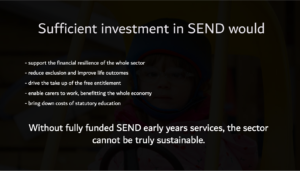
The key area of concern remains around funding of the SEND system, new research released by the Early Years Alliance that showed 92% of early years settings have had to fund the cost of supporting children with SEND themselves – with 53% doing that on a regular basis. 28% of settings have declined a place for a child with SEND, and 14% expect the number of places for children with SEND to fall because they lack the funding to provide the right support. Dingley’s Promise have raised the issue of funding for early years send at the All Party Parliamentary Group for Childcare and Early Education, and we hope that the plans to simplify the SEND system and access to funding across the country will go some way to addressing this issue. The green paper states that there is recognition that early years’ settings are heavily impacted by local funding decisions, which they often feel they have minimal influence over.
There will also be analysis of the use of inclusion funding in the early years addressing its ability to enable settings to provide the right support. The statistics above would certainly suggest that this in not working. Settings report specific difficulties where children are too young to access funding or are only able to access 15 hours of support when their entitlement is for 30 hours. If we do not resolve the funding issues for children with SEND in the early years, it will continue to drain the early years sector of funds at a time when it is already struggling.
We welcome the green paper’s plan for a simplified, standardised EHCP process that is digital and can travel across local authority boundaries. While only a small number of the total EHCPs in the country are in the early years, this will simplify the process for settings who often struggle with the administrative demands on this process. In turn, this will hopefully lead to more capacity in those settings to accept children with SEND who want to attend. It will also greatly help families who are either living on a border, or who need to move local authority area during the early years or at transition time.
The focus on increasing training in the early years for working effectively with children with SEND is much needed, but it should consider ensuring that every practitioner has an understanding of working inclusively with children with SEND, not purely focusing on a Level 3 qualified SENCO. Parents have expressed concerns about the impacts of only one person in a setting holding all the SEND expertise. For system-wide change, we recommend an approach that looks at raising the base knowledge levels of all practitioners around SEND, and ultimately this means that the standard Level 3 qualification should have a greater focus on this type of content.
Inclusion dashboards and local inclusion plans are in line with all the work we have done through the Early Years SEND Partnership, which suggests that to give children in the early years the best start and the best transitions to primary school, we must track key local data and really understand how inclusive we are. We look forward to sharing our learning on this through the consultation, and helping to shape what these dashboards look like, so that parents and professionals alike have a clear picture of what is working and what is not locally. We are committed to ensuring that every child who would benefit from accessing the mainstream in the early years has the opportunity to do so with the right support, however we must ensure that the mainstream is effectively trained, funded, and guided to support them effectively. Only once this investment is made will parents consider that mainstream education is a viable route for their child.
Taking into consideration the suggestions for changes to the current system, a few areas stand out across the age groups as needing more detail and consultation:
- Introduction of mandatory mediation. First impressions suggest this means an extra layer of bureaucracy for families rather than streamlining the current system. At worst, it could lead to exhausted parents being unable to go through another draining part of the process and not getting the right support for their children.
- Lists of available schools tailored to parents. Rather than make the process simpler for families, this could mean that they have reduced choice and are discouraged from applying to settings not on the approved list. The reasons for adding settings to the approved list must also be very carefully assessed and completely transparent so that parents trust they are still going to get the best setting for their child. In addition, there needs to be careful planning on how to ensure decisions are not diagnosis-led but are tailored to each individual child and their specific needs and situation. The report states that there must be ‘flexibility’ in all of this, but careful planning and monitoring is needed to ensure clarity and accountability with this process, putting families at the heart of decision making.
In conclusion, the Government green paper gives hope for real change to the current SEND system and reinforces the key role of the early years in achieving the best life outcomes for children with SEND.
For children with SEND in the early years to get the best experiences of early education and have the best chance of accessing the right provision, there must be significant improvements in resourcing and funding systems. Only with this level of investment will settings be able to offer the high-quality early intervention, support and transitions needed. We hope that this area is fully addressed over the coming months and years.
Standardised SEND systems have the potential to reduce issues across local authority borders and between various stages of the education system – issues that have especially affected the success of early years transitions to school, but these must be carefully developed, placing family’s needs at the centre of all planning.
Dingley’s Promise will strive to gather the views of families to feed into the consultation and ensure that the final document is fully reflective of needs and concerns on the ground. For any of this to make a real change, it is parents who must feel that it is transparent, and trust that the system is working in the best interests of their children. Without that trust, the fundamental issues the system is grappling with now cannot be resolved, and children and families will continue to have to endure exhausting processes to access their legal entitlements.
Read the full report here: https://assets.publishing.service.gov.uk/government/uploads/system/uploads/attachment_data/file/1063620/SEND_review_right_support_right_place_right_time_accessible.pdf