
Ordinarily Available Provision Research
The Cost of Inclusive Ordinarily Available Provision in England
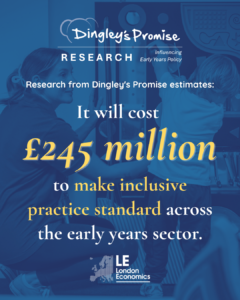
£47 million has been allocated by the Government to the IEYF (Inclusive Early Years Fund) – three times this amount is needed to deliver the expected level of support
There is no doubt that through the Best Start in Life programme and the introduction of Inclusive Early Years Fund, the government have shown their commitment make early years education more inclusive for children with Special Educational Needs and Disabilities (SEND). Inclusion is the foundation of a strong education for all children and vital for children with SEND, but research commissioned by London Economics and published by Dingley’s Promise today reflects that currently this commitment simply is not enough for settings to be expected to deliver Ordinarily Available Provision (OAP) an expected level of support and provision in early years settings.
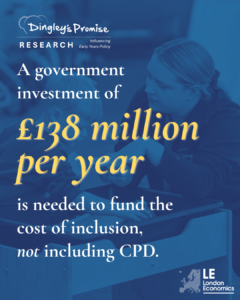
If Government funded training directly, the remaining cost would fall to £138 million per year, but this is still nearly 3 times the current investment of £47 million. Investment would ensure support is available not only for children with formal diagnoses, but also for those whose needs have been identified early, helping improve outcomes and reducing the need for more intensive support later in life.
“There is no doubt that the government’s aim of universally-inclusive early years provision that meets the needs of all children is a welcome one – but the reality is that unless settings are funded to meet the true cost of such provision, doing so will remain an uphill battle for many.
At a time of such intense focus on the need to provide effective support for all children, including those with SEND, this research provides a much-needed objective analysis of exactly what is needed to support high-quality inclusive practice across the early years sector.
As policymakers look to roll out wide-ranging SEND reforms, we urge them to take note of these findings and ensure that the sector has the investment it needs to turn the government’s ambitious vision into a reality.”
Neil Leitch – CEO of Early Years Alliance

Research conducted by London Economics on behalf of Dingley’s Promise